Why Your Website Alone Isn’t Enough in 2026
You spent real money on your website. Maybe you hired a designer, maybe you used a premium template - either way, it looks good. Clean layout, nice fonts, decent photos. And yet the leads aren't coming in the way you expected. The phone isn't ringing more than it did before.
If that sounds familiar, you're not alone. And the issue isn't your website.
Well - not entirely.
The reality is that in 2026, having a website is the price of entry. It's the starting point, not the finish line. What separates businesses that grow online from ones that stagnate isn't the design. It's everything that surrounds and supports the design.
The illusion of “just having a site”
Here's something a lot of web agencies won't tell you upfront: most websites today look great and do almost nothing.
That's not a dig at designers - it's a structural problem. A website built purely around aesthetics is essentially a digital brochure. It's something to hand someone who already knows you. It wasn't built to find strangers, earn their trust, capture their interest, and convert them into paying customers.
Visuals without systems don't scale. You can have the most beautiful homepage in your industry, but if there's no strategy behind how traffic gets there, no mechanism to capture leads, and no follow-up once someone bounces - you're relying entirely on luck.
And luck isn't a growth strategy.
What’s changed in how businesses grow online
The way people buy things has shifted dramatically, and it's still shifting. Consumers today don't land on a website and immediately pick up the phone. They browse, leave, see a retargeting ad, come back, read a review, check your Instagram, and maybe - maybe - fill out a form three days later.
That's what's called a multi-touch journey. And most small business websites are built like the old way still works: someone lands, they like it, they call. That path still exists, but it's not the majority anymore.
Trust is also harder to earn now. People are savvier. They can tell when something feels templated or impersonal. They want to see proof - case studies, testimonials, clear messaging about what you actually do and who you do it for. Vague doesn't convert.
Micro-conversions matter too. That's when someone downloads your freebie, books a discovery call, subscribes to your newsletter, or clicks through to a specific service page. These are signals. If your site isn't capturing them, you're flying blind.

What a website can’t do on its own
This is the part most business owners don't realize until they're six months in and frustrated.
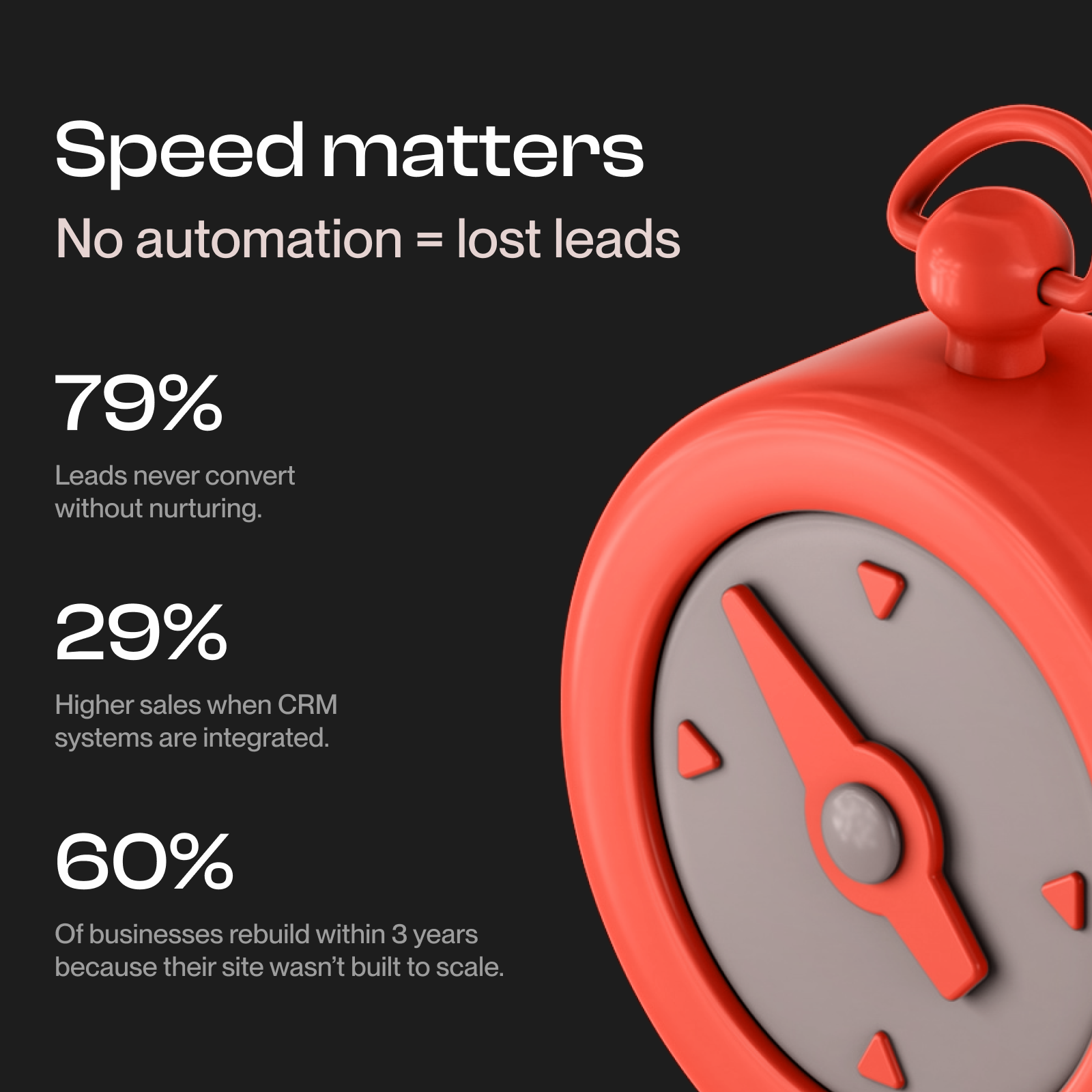
A standard website - even a well-built one - doesn't come with automation. There's no built-in lead nurturing, no system to follow up with someone who filled out a form but didn't book, no workflow that moves a prospect through your funnel while you're busy doing actual work.
It also doesn't talk to your other tools unless you make it. Your CRM, your email platform, your scheduling software, your analytics - none of that is connected by default. Someone has to build those integrations intentionally, and most websites aren't built with that in mind.
And your website definitely doesn't adapt to your business as it grows. The service you launched with isn't the same offer you have two years later. The funnel you needed when you had 5 clients is different from the one you need at 50. A static website that wasn't built to evolve will need to be torn down and rebuilt - and that costs more than doing it right the first time.
What actually drives conversions in 2026
If design alone isn't the answer, what is?
System-first thinking. That means before anyone touches a color palette or a font, you've mapped out how a stranger becomes a lead, how a lead becomes a client, and what tools need to talk to each other to make that happen. The design serves the strategy - not the other way around.
Performance-ready foundations matter more than they ever have. Google is paying closer attention to page speed, Core Web Vitals, mobile experience, and technical SEO signals. A beautiful site that loads slowly or breaks on mobile is actively working against you.
And the businesses that actually grow online are the ones iterating. They're looking at heatmaps, form completion rates, drop-off points. They're making small changes based on data and watching what moves. That's not complicated - it just requires having the right tools set up from the start.
Why templates fall short (and cost more later)
Templates aren't inherently bad. But they're built for the average business, which means they fit your specific business the way an off-the-rack suit fits someone who isn't exactly average proportions - close enough to work, not quite right enough to impress.
The real problem shows up when you try to grow. You want to add a booking system - the template wasn't built for that. You want to connect your CRM - someone has to hack something together. You want to personalize your homepage for different audience segments - good luck. Every integration becomes a workaround, and workarounds slow you down and cost money.
Things like booking flows, CRM connections, analytics pipelines, and email automations aren't afterthoughts. They're core infrastructure. When you try to bolt them onto a template that wasn't designed with them in mind, you're paying someone to retrofit your house rather than having built it right to begin with.
The smarter alternative: launch with a system
This is exactly why we built our Launch Kits at VX Studio.
The idea is straightforward: instead of handing you a website and wishing you luck, we build you a complete system designed around where your business is now and where you're trying to go.
That means strategy comes first. Then content. Then design. Then integrations - your CRM, your scheduler, your automations, your analytics. All of it built together so it actually works as a whole, not as a pile of disconnected tools held together with hope.
One investment covers the pieces that most agencies charge you separately for, or skip entirely. And because everything is built intentionally from day one, you're not ripping things apart six months later when you want to scale.
It's built to grow with you - not to be replaced by you.
Final thoughts: Build once, scale smart
Here's the honest version of what most business owners learn the hard way: a website that looks good but wasn't built as a system will cost you more in the long run. More in rework. More in missed leads. More in integrations someone has to duct-tape together after the fact.
The smarter path is to start with the outcome in mind - what does this site need to do, who does it need to reach, and what systems need to be in place to make that happen - and then build toward it.
Skip the guesswork. Avoid the rework. Start with something designed to deliver results, not just impress your mom.
If that sounds like what you've been looking for, let's talk.



Get our latest insights